 Hockey Hub
COPY AND ADAPT
A hockey player self-evaluation template for game check-ins
A player check-in works best when the questions point to behaviors a player can remember. Use this sample to start a conversation after a game or scrimmage, then adapt the questions to your age group, role and current focus.
Give the stars a shared meaning
A number is easier to discuss when everyone understands what it describes. Use the same anchors for repeated questions and ask for a moment that supports the answer. A player may rate the same behavior differently after a difficult game; ask about the context before drawing a conclusion.
The following anchors are a suggested conversation aid, not a validated performance scale. Star ratings in Hockey Hub are self-evaluations. They do not independently grade skill, effort, character or future potential.
| Rating | Suggested meaning |
|---|---|
| 1 | I rarely noticed or tried this behavior today. |
| 2 | I noticed it sometimes, but usually needed a reminder or reacted late. |
| 3 | I used it in some situations and can name an example. |
| 4 | I used it regularly and can explain when it helped. |
| 5 | I used it consistently in the situations I faced and can explain my choices. |
Choose a small set of behavior questions
You do not need every question after every game. Select the topics that match the review, and keep the wording stable long enough to revisit a useful pattern. A coach or parent can add, edit or remove questions for future Hockey Hub check-ins; published reviews keep their original question snapshots.
- Manipulation & deception: Did I use my eyes, body or pace to give the opponent a different picture before my next action?
- Manipulation & deception: Did I notice an opportunity to change speed or direction to create space?
- Offensive creation: Did I move into a useful support position after passing the puck?
- Offensive creation: Did I look for a way to create time or space for a teammate?
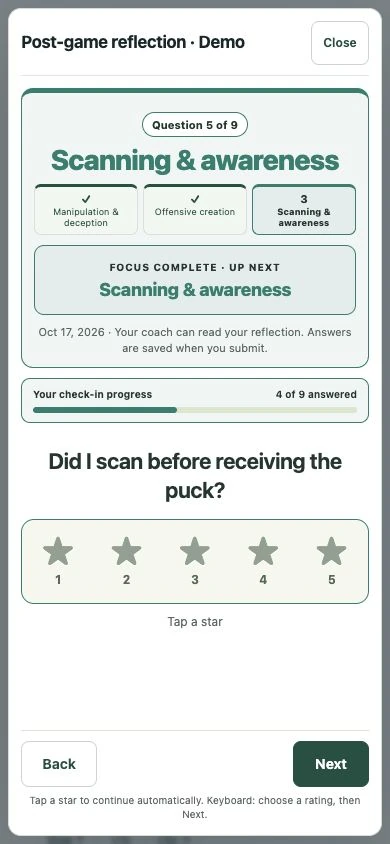
- Scanning & awareness: Did I look before receiving the puck so I knew an option?
- Scanning & awareness: Did I check where pressure and support were coming from before my decision?
- Competitive habits: After possession changed, did I take an immediate action that helped our next play?
- Competitive habits: When a play did not work, did I return to the next useful task?
Add a reflection the player can own
Use a short written answer to make the review concrete. “Play better” is difficult to act on; “look over my inside shoulder before receiving the wall pass” is something the player can notice and try. Let the player choose a focus before the adult adds another one.
My Difference Making Moment can describe a smart support route, a recovery, a scan, a communication cue or another useful action. It does not have to be a goal or a highlight play.
Copy this template
Game / scrimmage:
Focus topic:

My 1–5 self-rating for the selected behavior:
A moment that supports my answer:

My Difference Making Moment:
What did I notice before making that decision?
What other option could I have considered?

One action I want to try next game:
What cue will remind me?
What feedback would help from my coach or parent?
Run the phone check-in without making it a test
- Tell players which focus topics matter for this game or scrimmage.
- Connect a few useful game moments when video adds context.
- Publish the check-in. Each player opens their personal link and uses their own login.
- The player taps one of the stars to answer a rating question and advance; written and checkbox questions use Next.
- The player reviews their answers before submitting.
- Respond to an example or question in the reflection. Use the number as an opening for feedback, not a public leaderboard.
Review trends carefully
Check-in completion tells you who submitted, not who watched every clip. Hockey Hub does not track video watch completion. Topic trends represent the answers players chose, and different question mixes can change what an average means.
Compare repeated behaviors alongside the player’s examples and the situations they faced. A player who starts noticing more detail may become more critical of their own performance even while learning. Discuss the reflection before deciding what the rating means.
Keep reflections private
In Hockey Hub, the managing coach or parent and accepted assistants can see workspace submissions. Players see their own responses; teammates cannot browse one another’s check-in answers. A child’s separate club team remains separate from a parent-managed family workspace.
If you use this template outside Hockey Hub, decide in advance who can read it and where it will be stored. Do not publish a child’s answers or personal coaching notes as marketing content. Use fictional examples for public demonstrations.